
Articulating Haq حق
Five years since the Citizenship protests, six young Muslims muse on what it means to be of India.

At the start of this year, I carried out a series of interviews buoyed by the interest in India’s Muslims (after my memoir’s release in 2024 but) mostly because of the genocide in Gaza, and a growing consensus that in a country farther east of Jerusalem, with one of the largest Muslim populations in the world (200 million at last count)– a country known for giving the world nonviolence– was tipping into Islamophobic free fall.
This eclectic group of young Indian Muslims reconsidered the past five years as we talked. From Delhi to Kerala, Bengal to Lucknow, some raised in Middle East diaspora, others discovering Europe as students, these were early and late-millennial Indians, a disparate lot whose lives and myriad experiences were folded down and flattened by 12 years of the Hindu supremacist BJP government’s three consecutive terms in power.
During the second term, in the jubilance and shadows of the Citizenship Protests of 2019-2020, this group discussed with me, how they negotiated their sense of Indian-ness alongside their Muslim-ness: what a rapidly changing country was telling them, what their evolving sense of belonging and citizenship marked, which narratives they continued to carry, which lay discarded alongside other human rights in the “world’s largest democracy”.
An heavily edited version of these conversations appeared in Acacia Magazine earlier this year. As we complete five years to the start of these groundbreaking protests– five years in which many of the movement’s heroes were arrested and now remain incarcerated without conviction– it felt important to allow these voices their full breath and sound, even if justice and deliverance may remain out of reach.
Articulating Haq
Indian Muslims reimagine resistance and belonging under Hindutva
Aamir Aziz remembers it was in 2014, after the Hindu nationalist BJP led by Narendra Modi won their first term, that lynching Muslims became “a thing.”
“It was a phenomenon I couldn’t make sense of. The image got stuck with me of the (truck) driver and conductor, who were beaten, killed, and hanged from a tree for transporting a cow. It never left me.”
Aziz, who was then a student at Jamia Millia Islamia University, one of India’s finest Muslim institutions, wanted to be a poet and actor. Instead, he found himself called to bear witness to a moment of seismic shift in India’s long claim to a successful model of democratic secularism. Haunted by is moment he calls a “festival of killing,” Aziz started to pen urgent ghazals about lynching, laid them to music, and released them online. The first to go viral was a song called Achche Din Blues.
Across the globe, the modern Indian nation state has maintained a reputation, especially in its fairly raucous neighborhood, of great religious tolerance, stunning ethnic and linguistic plurality, an exemplar post-colonial state which has remained reasonably politically stable despite spurts of violent conflict. Yet in 2014, with the ascent of a party whose representatives openly fear-mongered about its Muslim citizens as rapists, invaders, illegals, murderers, and terrorists, normalized killing young Muslim men under the pretext of cow slaughter, or “love jihad,” it felt like India’s Muslims, its largest religious minority, were being plunged into a rapidly deteriorating insecurity about their future and belonging. (For a detailed report, see this by Jason Stanley)
Afreen Fatima was graduating in 2019 from Aligarh Muslim University (AMU), another prominent campus known for its progressive Muslim politics and long, illustrious history in India’s freedom struggle and culture-making when she felt unable to peel her gaze from a viral video of 24-year-old Tabrez Ansari, tied to a tree by Hindutva mobs and forced to chant “Hail Lord Ram” before being brutally lynched.
“I remember thinking that Tabrez did not even look Muslim… he didn’t wear a skullcap, or a kurta pajama. He had bleached hair!”
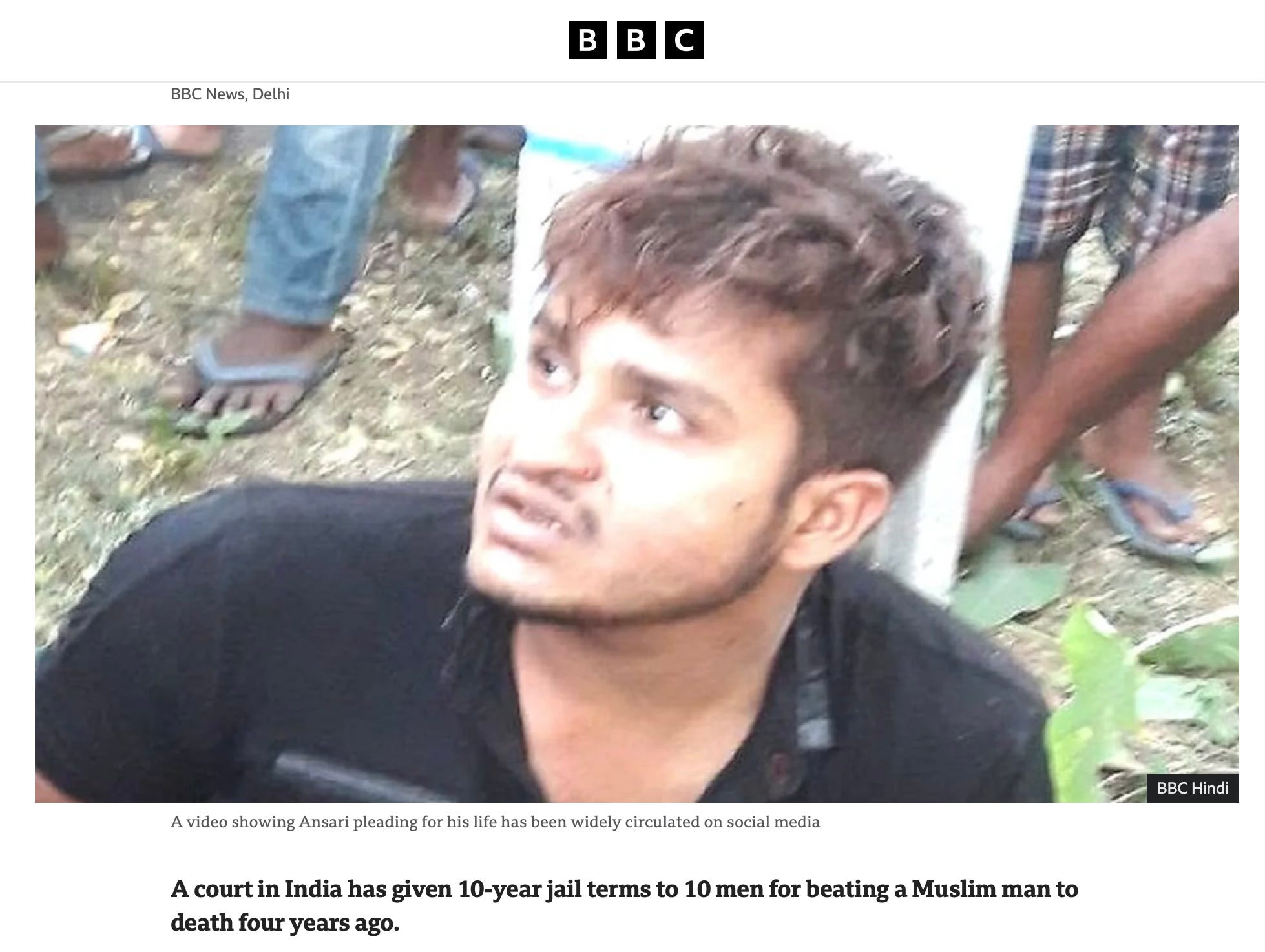
Read the full BBC report here.
Shortly after when Fatima was admitted to the PhD program in Delhi’s Jawaharlal Nehru University (JNU), this Taylor Swift-humming, Princess Diaries-reading young woman decided to take the hijab.
“I wanted to be seen on a “secular, progressive” campus, thriving, accomplishing, speaking, taking space up in a hijab.”
As the regime’s influence on India’s foundational agencies and institutions grew, replacing governors, judges, chancellors, boards, and heads of cultural organizations with party loyalists and fringe hatemongers, protests erupted across campuses. Within the first term, cable TV news seemed to cave to the jingoistic rhetoric preferred by this regime. By the end of the BJP’s first term, student protestors and young activists were frequently being labelled “anti-nationals” and “insurgents” by prime-time news hosts.
Sara Ather, a young architecture student was studying in Frankfurt at the time. She remembers watching anti-Muslim violence intensify back home, and yet struggling to explain to her European friends how sharply India had pivoted towards authoritarianism.
“They didn’t know that India had this history of the Muslim question,” she says.
Muslims of Ather, Aziz, and Fatima’s generation had grown up in an era of blatant micro-aggression, the pressure and expectation to restrain one’s religious self in favor of validating one’s secular self.
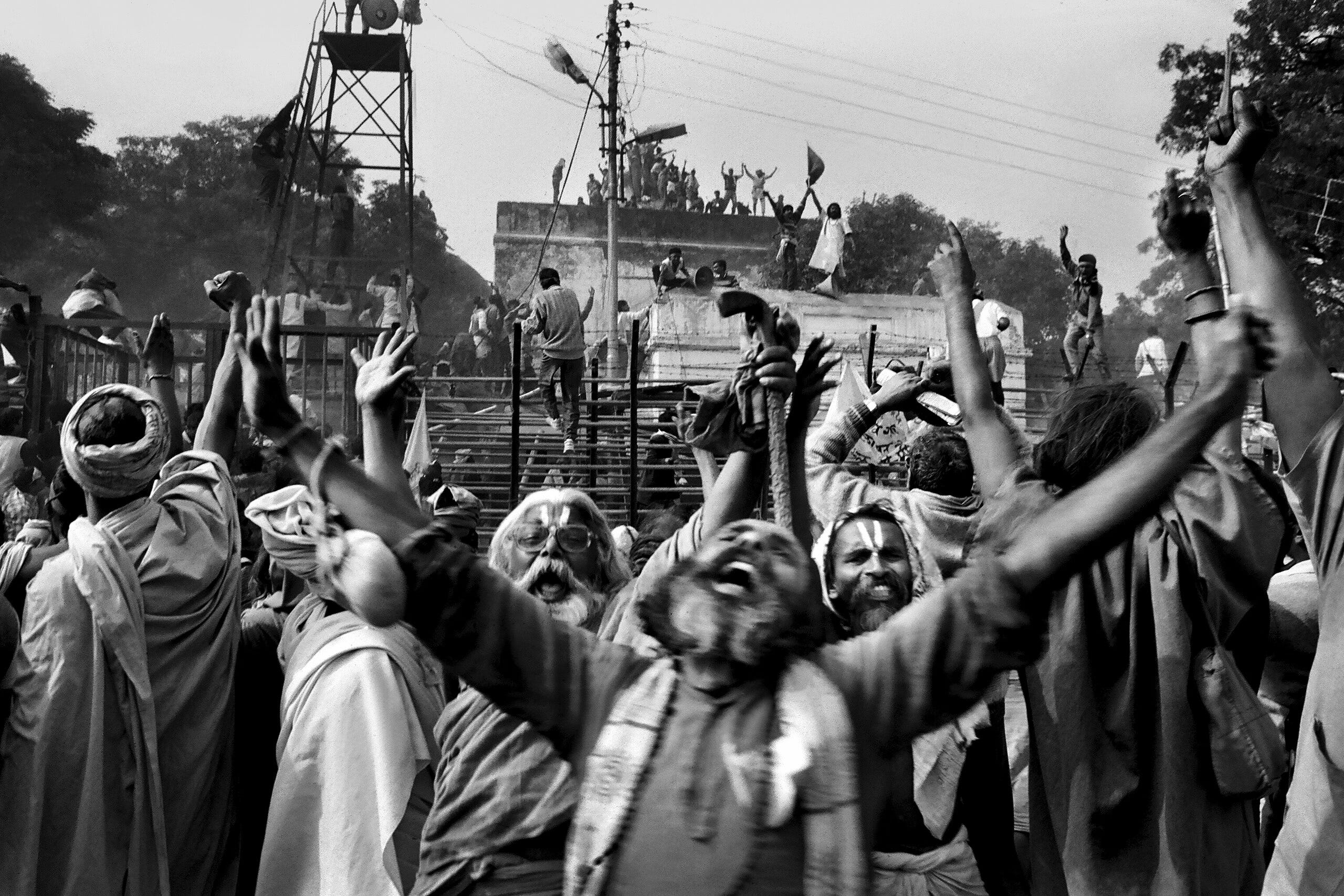
Babri Masjid Demolition on December 1992, by Duggempudi Ravinder Reddy (own work, CC BY-SA 4.0)
On December 11, 2019, the re-elected BJP government, now with a super-majority in the Parliament, tabled and passed a controversial proposal called the Citizenship Amendment Bill. It was shortly after signed into law by the President, making it the Citizenship Amendment Act (CAA). The law empowered the government to grant citizenship to asylum seekers from India’s neighboring nations based on them belonging to five religious groups: Hindus, Christians, Buddhists, Jains and Sikhs. Muslims were conspicuously, and in clear contradiction of India’s secular constitution, left out. Earlier in November, the Home Minister had promised in Parliament that a National Register of Citizens (NRC), which had only been implemented in the eastern state of Assam, would now be executed nationwide. People would have to queue up outside administrative offices to prove through paper evidence that they were born or naturalized Indians. And those who couldn’t prove their belonging would be assimilated back in through the CAA. Except Muslims.
According to Dr. Adil Hossein, a social scientist from Azim Premji University, the role of the CAA coupled with the NRC, in the imagination of right-wing followers of the BJP, was a way of righting a grave historical wrong.
“1947 [the Partition] was supposed to have solved the “minority problem” but they [the right-wing] feel it didn’t fully happen because India chose to frame a secular constitution.”
In other words, supporters of the regime were convinced that secularism was India’s fatal flaw, a weakness keeping the country overpopulated, economically crippled, under-resourced, all impediments to its potential rise to a global superpower. Bengali-speaking Muslims, particularly, faced the brunt of the NRC in Assam–– its design flaws had resulted in the detention or rendering stateless of thousands of Muslims.
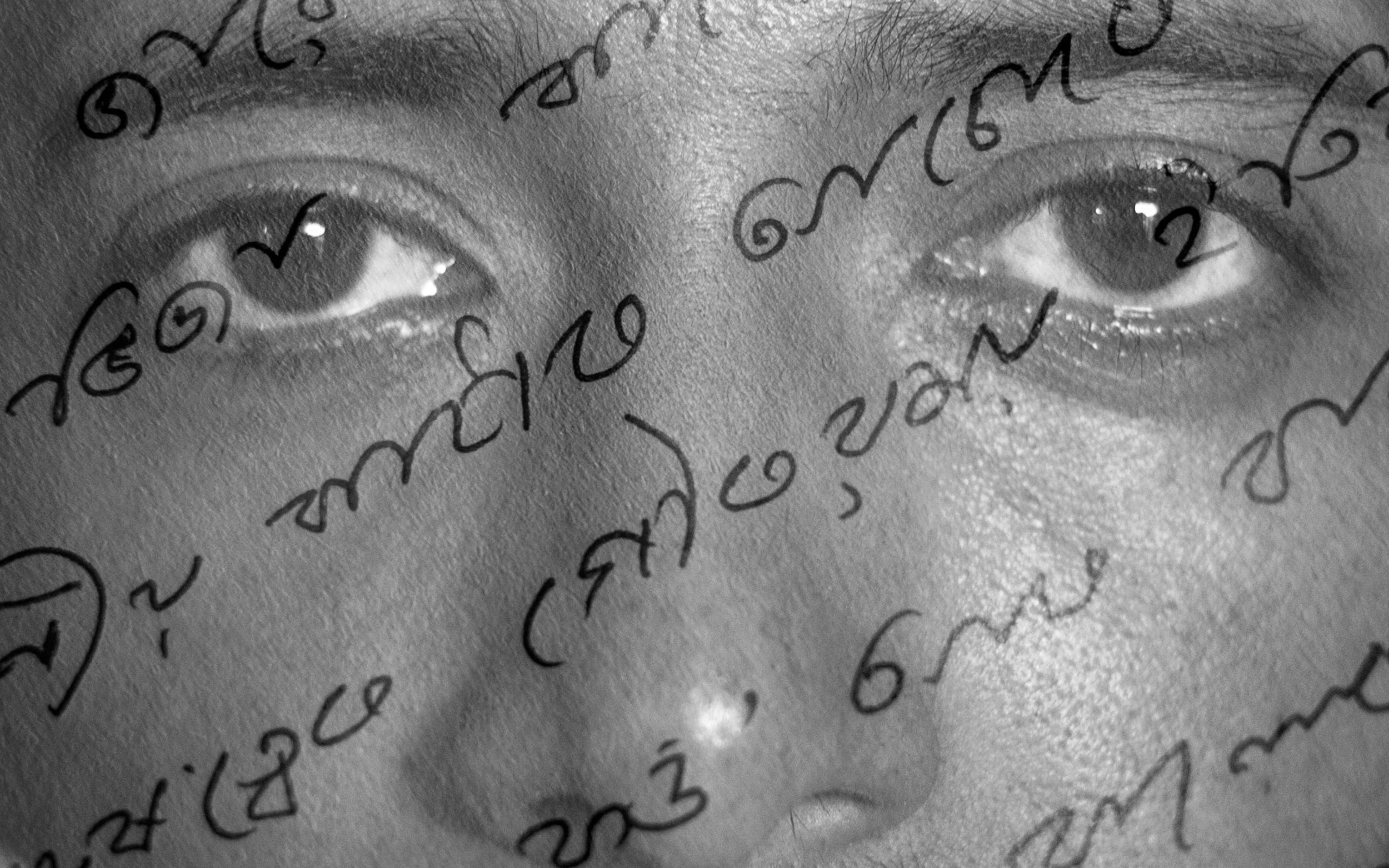
For more on the disenfranchisement in the eastern states, explore these photo projects by Zishaan A Latif.
The day after the bills were introduced, students at JNU, including Fatima, met to discuss what CAA-NRC meant for the larger Muslim population. The students drafted a parcha, a pamphlet, explaining the bills, with calls to action.
Twelve miles away, in the Muslim ghetto of Jamia Nagar, another young Muslim student, Nabiya Khan was part of a community self-help group. She and a group of young volunteers from the area organized medical camps, surveyed people’s health, and worked to address children’s educational needs in a forgotten part of the city where literacy was low, as was access to basic amenities. On December 14, as murmurs against CAA-NRC grew, students from Jamia Milia Islamia, announced they would march towards the Parliament. Khan and her brother were on campus for a meeting about a children’s library when they received a call.
“The marchers had barely reached the end of the lane when tear gas was fired. We ran deeper into the campus, thinking we’d be safe there.”
The police had started to attack the marchers. Khan remembers seeing stun grenades come flying over the campus walls. Smoke everywhere. Her brother dragged her to the back gate. They snuck out through the lanes and alleys, trying to find their way home, which was less than a mile from campus.
“But it was like a war zone,” she says. The usually lively night bazaar was shut, electricity cut off, the internet jammed. “We spent all night trying to contact people, hearing stun grenades go off in the distance.”
“Protest was not new to me,” Aziz says of that same night. “But I had never seen police personnel with this sort of scary body language. We’d been tear-gassed, beaten with batons. But this time, it felt like it would never stop.” He says he realized that night that the country has changed. “It wasn’t even hostility now. It was something else.”
Fatima, who was also at Jamia’s campus that night, was similarly traumatized. She and a friend were drinking chai at the campus canteen when they saw the police enter with batons, bashing students in their way. They ran into the library, locked the doors, switched off the lights. The police shot tear gas in. The students were choking. They kept moving floor by floor towards the terrace, trapped. Cops finally broke into the library, as did goons from local right wing organizations. They indiscriminately beat anyone crossing their path. One student lost an eye. Many were injured.
Fatima called her friend, a student at her alma mater AMU, asking if him to rally the press, ask them to rush to Jamia, report, use social media. Her friend’s response chilled her. The state police had arrived at AMU too, and were beating, and tear-gassing students.
Fatima questions why such indiscriminate and brutal violence was unleashed on peaceful protest, but also how the police chose to attack two of the country’s oldest Muslim campuses at exactly the same time. Few hours later, the firing stopped and Fatima escaped to hide in a friend’s aunt’s house.
In the early hours of the morning, she contacted another activist friend, who told her that the ghetto of Jamia Nagar was mobilizing. She should come to a neighborhood in Jamia Nagar called Shaheen Bagh.
“Magic!” is how Nabiya Khan recalls what happened next. “The very next morning, everyone was back on the street! Nobody looked scared. Even my elderly parents came!”
Fatima arrived at Shaheen Bagh to see local men and women dragging mattresses and blankets from their homes. They took over the main street, also an arterial national highway cutting through the heart of Delhi. What happened over the next few weeks grew into the now globally recognized Shaheen Bagh encampments.
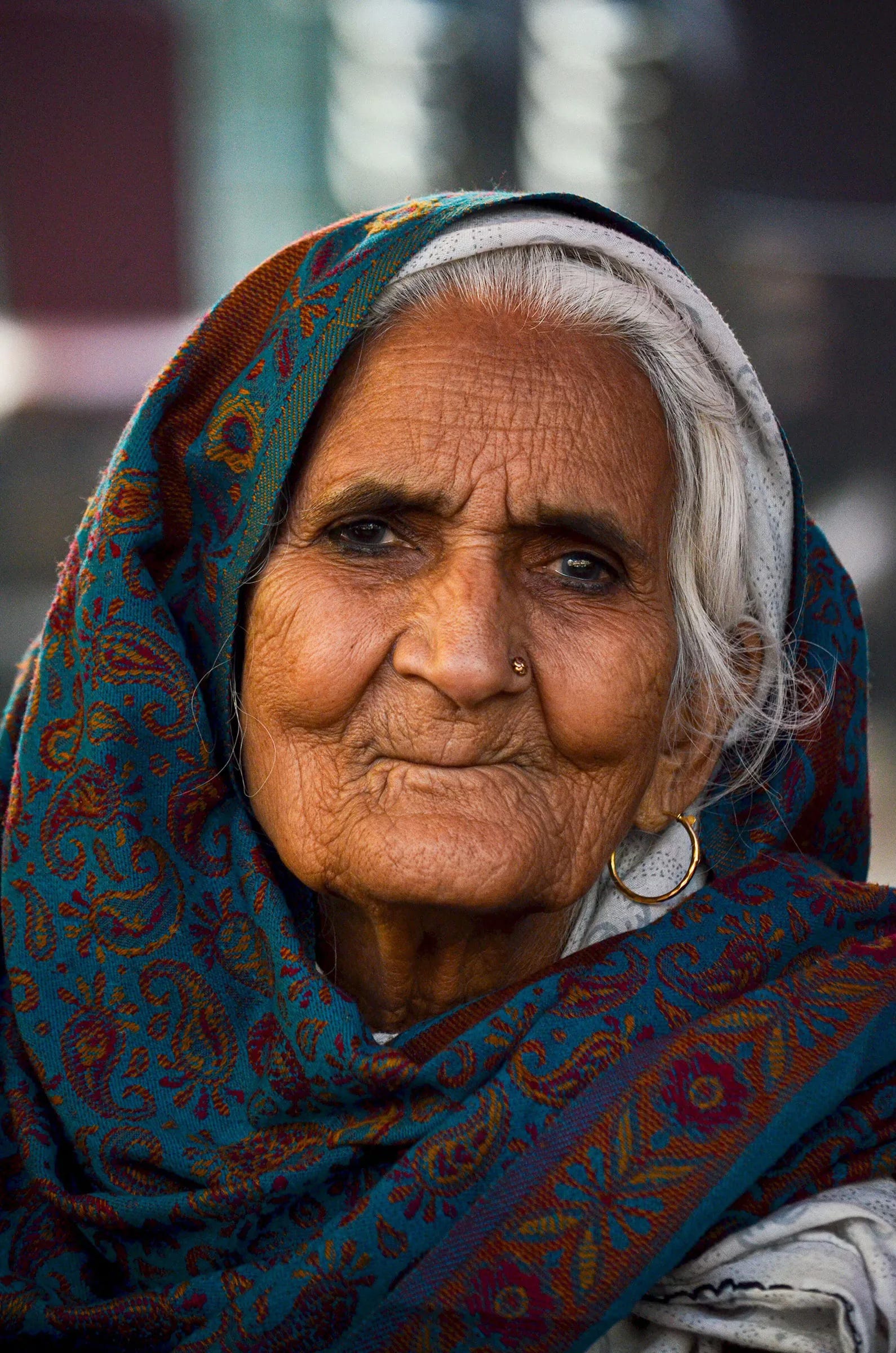
A grandmother from Shaheen Bagh in the Time 100 List 2020
Each day more women showed up, and stayed longer into the night. Fatima, Khan and others collected funds and arranged for community tents. This was all strange and new for Shaheen Bagh, where women had never politically activated like this. But they couldn’t help themselves after what the neighborhood, city, and country had witnessed the previous night.
“It wasn’t a mob that had beat their children.” Khan explains. “It had been the state, the police, who had humiliated their children. So, these women were questioning, how are we safe in our own country? Now we will show them.”
Aziz too had lived in this ghetto as an out-of-state student for almost a decade. He reveled in standing with the very families who had once housed and fed him.
“These communities were the smartest. They didn’t understand jargon, or complex literature or poetry, but they understood truth.” Aziz says.
“Truth is not a slave of language, or worldly exposure. One of the grandmothers even said: ‘We know who comes here to preach, who comes here to talk, and who comes to listen.’”
As news started to trickle of this strange phenomenon where hijab-wearing housewives and tasbih-clutching grandmothers had occupied a national highway, their husbands and sons and adoptive community ensconcing them, rotating household duties, maintain a day-and-night vigil, singing songs of liberation in an unheard-of Delhi ghetto, crowds started to flock to it.
“There was a sense of festivity,” Aziz says, “as if people were meeting Shaheen Bagh for the first time. Earlier if you tried to take an autorickshaw from the railway station to Jamia Nagar, drivers would refuse to go.”
Aziz smiled at one particularly vivid memory which became emblematic of the site: a young, urbanized Hindu student smoking her cigarette beside an elderly, bearded Muslim man who was drawing on his beedi, both huddled around a campfire.
“This is what movements do,” Aziz says, “A society suddenly covers a hundred years of distance in a few days. Every night at Shaheen Bagh felt like a decade.”
A thousand miles away in the southern tech capital of Bengaluru, theatre artist and activist Nisha Abdulla was restless. Until the attacks on the students, the CAA-NRC laws had been peripheral issues in Abdulla’s worldview. Raised in Oman, in an educated migrant South Indian family, Abdulla’s idea of Islam had flourished in relative gentleness to the north’s harsher contestations with Partition and decades of socio-political tensions. With the rise of Modi and an independent journalist’s murder in her chosen home city of Bangalore, Abdulla had been thrown into a rapid political awakening. Since then, Abdulla had invested time and labor into nurturing networks of local artists, storytellers, and citizen groups.
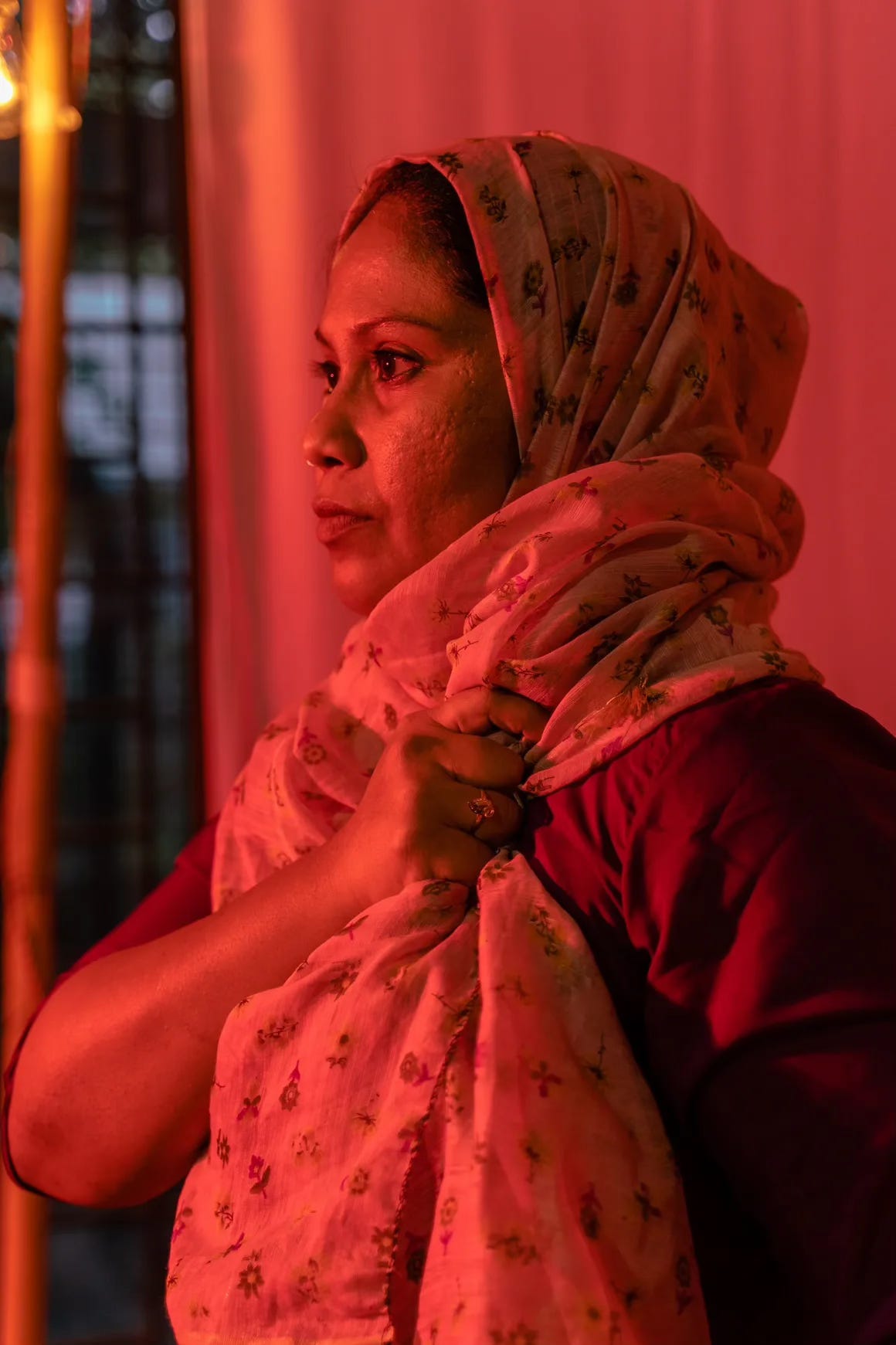
Abdulla in her one-actor play “wepushthesky”, inspired by the 2019 protests. The play has travelled to festivals in New Delhi, Singapore, and Jenin.
“The force with which the state came down on the students, showed me that the more afraid they are the more violent they get.” Abdulla says. Immediately after the Jamia and AMU attacks, she started to show up at the local town hall with her network. Like the students in Delhi, here too, they made and circulated simple multi-lingual pamphlets. Abdulla translated through social media the intentions of the protest and the flaws in the legislation to citizens in Bengaluru who still weren’t showing up in big numbers. Slowly the tide turned. A sister-site to Shaheen Bagh, Bilal Bagh was established.
In Frankfurt, Ather’s classmates couldn’t understand why she cared.
“Before I found allies, I found a lot of people gaslighting me, treating me as if I had a fever. As if this didn’t concern my internal being. For them liberation was to leave your country and run away. It was hard to explain that your country doesn’t leave you.”
Slowly as they continued to talk, a solidarity formed–– some Hindus, Muslims, allies from the international student body. They met with local Indians from the community. Finally, on a frigid morning, a large contingent marched to the Indian Embassy, where embassy staff rushed to shutter the windows on them.
In Kolkata, Dr. Hossain watched as a sister-site was launched in Park Circus. A female friend and him walked through it one night, stopping for tea in what used to be a “male-dominated area.”
“We were there at 3 AM, discussing citizenship. And the men around had accepted this as normal. These conversations on what it means to be a Muslim, or a woman or a caste-oppressed person, what does shared struggle mean–– a sort of generational transformation happened.”
In Bengaluru and Frankfurt too, Abdulla and Ather witnessed a similar intersectionality emerge.
“Bilal Bagh was a do-or-die moment for me,” says Nisha. “We cannot begin this conversation of secularism, without holding these plurals—of being Indian, Muslim, a woman, of an oppressor class, a previously colonized body, holding half languages ––within our bodies.”
For Ather it felt like Indian Muslims had never had a fully realized a vocabulary to define who they were, other than Muslims who had remained in India, refused to migrate to Pakistan. Shaheen Bagh changed that.
“Our lived experience as a minority created an alternate language that we exchanged and understood: Not being allowed to rent or buy homes, discrimination for consuming meat or eggs, lack of access or representation in education or good jobs. This latency in our experience had never had a public presence. And for the first time in my life, I got introduced to Dalit (anti-caste) politics. This too was by design: we weren’t allowed to share a vocabulary [with caste-oppressed peoples].” In Berlin, Ather watched as leftist and anti-caste slogans melded in solidarity with Indian Muslims. Never since India’s independence movement, had marginalized groups across faith and region showed up in such significant organizing.
“We started to realize that even though their (caste) oppression has gone on for centuries and ours has for decades, the tools and processes are the same. And that the oppressor’s generational knowledge of caste was operating.”
Aziz says the women of Shaheen Bagh were modeling this for the country, the way they articulated their own generational wisdom. The cultural memory that resurfaced in their community library, songs, slogans––of the successive movements of anti-colonial struggle, and the role of India’s Muslims in these, and in the construction of a nation, Aziz thinks was transformative. “Like the 1857 revolt, the women would talk about it, call it ‘gadar,’ a mutiny.” People were remembering a language.
“The women were saying, ‘if guns are pointed at the children, they will need to pass through us.’ A language of such compassion can only come from a culture rich with resistance.”
This moment also highlighted another question, that of a Muslim woman’s agency: a figure that had long been cast in the role of the suffering, oppressed character within a patriarchal community, one that both the Hindu Right and Left often cast themselves in savior roles to stage interventions. As liberal Hindu academics and news reporters, often women, descended on the protest sites, extracting interviews and scholarship, religious studies scholar Dr. Zehra Mehdi in Lucknow, observed an elderly Muslim woman protestor refuse to engage.
“This woman was an ustani, a Quran teacher, and I watched her shirk away from a woman journalist who tried to interview her,” Mehdi recalls. “Later when I was sitting with her, she said, ‘hum kuch nahin bataayenge, hum bhi Zaynab hain.’”
The woman was citing Lady Zaynab’s right to agency in speech, Hazrat Ali’s daughter, who after the slaughter of her people delivered a defiant sermon in the court of the tyrant Yazid. Mehdi sees this articulation as particularly telling.
“What Zaynab says in that moment is not, ‘you did this to my family,’ but that ‘you did this to my community.’ Her loss is so profound that she refuses to disgrace it by bringing it to the court. What the court needs to address is injustice, not hers as a sister, but that of the ‘qaum,’ the community.”
Mehdi mentions other instances of elderly Muslims in these sites casually and masterfully quoting both Quranic and Hindu texts.
“When people think of India, we only imagine myth as being the Hindu epics,” Mehdi says. “Which is great! But they aren’t the only ones. Minorities are the ones with a dual consciousness. The colonized have always been forced to know more than the colonizer. We know Hindutva better than its followers. Because they only know the aim of their oppression. We know the aim and we know its impact.”
Mehdi also feels India’s liberals conveniently obscure this nuance, when they expect protest to be sanitized, free of all religious meaning and symbolism.
As Afreen Fatima visited the various sister-sites, addressing crowds of tens of thousands, her words were singled out by India’s cable news pundits who took offense to their Islamic-ness. A clip went viral in which she says, “If your idea of India does not allow me to protest as a Muslim, then I reject your idea of India.”
“Muslims wanted to protest as themselves.” Fatima explains. “In Allahabad, when I gave this speech, the entire park filled with women, they were all crying. Uncles came up to me with tears in their eyes, patting my shoulder, thanking me for saying what I said.”
Khan, like Fatima, also traveled to the different sites, reciting poetry, and felt similar frustrations. In every city, every protest site was organized and housed within a Muslim neighborhood, often an economically depressed and ghettoized one.
“The majority (Hindus) could have organized within their spaces. But all the activism, the subsequent police violence was happening in ours. People visited these sites for ‘protest tourism.’ They’d say, ‘Oh the food is so great, but the place is so dirty…’”
Indeed, influencers, indie musicians and Bollywood actors showed up. Shaheen Bagh became a photo-op for Left-leaning politicians. Slowly the hit pieces followed. One write-up called it a site for budding romance. Another alleged that women were running a sex-work racket. The communities around these sites wanted to be witnessed, listened to, and to welcome allies. Instead, they experienced whiplash between the right-wing’s slander, and the liberal tone-policing.
“We were being told our movement needs to be digestible. But people forget that so much of our strength is coming from Islam. The feeling that your neighbors, your parents and siblings have a right on you, your community has a right on you, that people must never go unfed at these sides, the very idea of sabr with which these women were sitting in the freezing cold… these come from our faith.”
Every Friday Shaheen Bagh’s women would fast. All day people would study the Quran, chant with their tasbihs. And yet, the mood at these sites would change after maghrib, when the liberal media and crowds would arrive, it would turn into a televised performance. The women would feed them, sing with them, talk to cameras. But it is the time they would spend through the day with just each other, Khan feels, that was recalibrating conversations within the community. She felt a reduced hostility towards contested issues within the Muslim community.
“Suddenly I could talk about wearing a hijab but not glorify it when it is forced on someone.”
Mehdi believes spaces like Shaheen Bagh re-imagined the long discursive tradition within South Asian Muslims. Liberals, she says, “are always trying to flatten our differences in service of the ‘nation,’” she says. “But people forget, the nation is not even a hundred years old. We have people living who are older than the nation, who have witnessed more.”
This is an important way to read the 2019-2020 protests as more than just a short-lived encampment movement, Mehdi believes, that Indian Muslim women were finally curating from their religiosity an independent political feminist vocabulary for themselves.
Read more of Dr. Mehdi’s incisive analysis on Indian Islamic secular thought here.
In February 2020, gruesome riots broke out in the northeastern parts of Delhi, miles away from Shaheen Bagh, in which 53 people died over three days of looting, burning and police firing, two thirds of them Muslims.
“As soon as the violence started, the future was decided,” says Aziz. “It was demonic, for a protest like ours to turn into a pogrom. We knew immediately that Shaheen Bagh could not continue.”
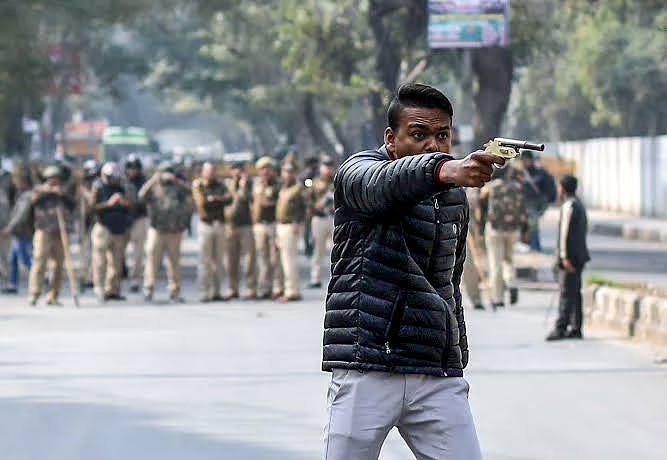
Gunman attacking protestors. Photo by slain Pulitzer-winning Reuters photographer, Danish Siddiqui, Delhi 2020 (National Herald)
Aziz, Khan, Fatima and others at this epicenter were devastated. They felt immediately rudderless, after all the constructive energy everyone had poured into the movement, to now face such volatile repression. The aftermath of the pogrom brought guilt too. Many of the movement’s “heroes,” young students, poets, and activists like them, were made examples of, charged with “anti-national speech or act.” Most of them still languish in Indian prisons. Aziz believes this was by design.
“This was the first time, since Independence, when young Muslim boys and girls rose to so much prominence because of their articulation, understanding, and leadership. They were sent a clear message.”
Read Nabiya Khan’s full piece on incarcerated Muslim students and activists here.
Khan had to relocate. A friend of hers tried to attempted suicide because of how much she was harassed. Khan says, educated people like her would earlier never dream of leaving their communities. Now their incarcerated friends write to them asking, ‘when are you leaving?’
In March 2020, COVID broke out across Indian cities. The sites dwindled down to symbolic spaces, manned through the day by a handful of masked volunteers. Even as arrests and charging of Muslims continued, the news and public attention quickly shifted to the pandemic. On March 24, a hundred and one days after the women, men, and children of Shaheen Bagh had come out to assert their humanity, the site was officially raided by the Delhi police, the last nine people, amongst them six women were forcibly removed and detained.
“There is constant police presence in Shaheen Bagh now.” Khan says. “Everyone had so many aspirations from this site. Now their only aspiration is they don’t want to go to jail.” She says, she used to judge some people who wouldn’t show up to protest. Now, she says, she understands.
“No one deserves this, why should people have to be so courageous that they must send their children out in this dangerous time to fight for their rights. They shouldn’t have to.”
Five years since that morning in December 2019, Aziz continues to fight back despair and fatigue.
“We realize now in retrospect that only those suffering will have to figure a way out.” Because the minute violence and crackdowns came, allies disappeared, he says. “But we also understand that despair cannot be the answer to killing.”
He says, in the midst of the genocide in Palestine, as Modi’s government won a third term, deeper questions and insecurities have risen.
“Now there is an international hostility. BBC is reporting [on Gaza] like our local [right wing Indian] TV. This is going to require a trans-continental understanding. We must re-consider what we understand of fascism, or Nazi Germany. Workers from central India are going to Israel (to take the place of Palestinian workers).”
Aziz says he has very little patience for fellow Indian liberals to step up. He sees them as suffering from an “aftermath ideology.”
“They are waiting for gas chambers before they declare something as fascism.”
Fatima, amongst this group, faced the most direct assault of the BJP’s punitive measures. In 2022, the state BJP leadership ordered the demolishment of Fatima’s home. This destruction of Muslim property and religious monuments by the state has become so notorious, that there is now a term––“Bulldozer justice” –– for it. In a 2022 Indian Independence Day parade in New Jersey, diasporic Hindu right-wing groups marched with a bulldozer float.
Fatima speaks with remarkable candor and dignity despite the injustice meted to her family.
“When my home was demolished, my mother was sitting on the prayer rug,” she says. “My sister and I were huddled around a mobile phone watching the real-time demolishing of our home. And for a split second I looked at my mother. And she looked at me. And she simply said, ‘Hasbunallahi wa ni’malwakil.’ And it calmed me down.”
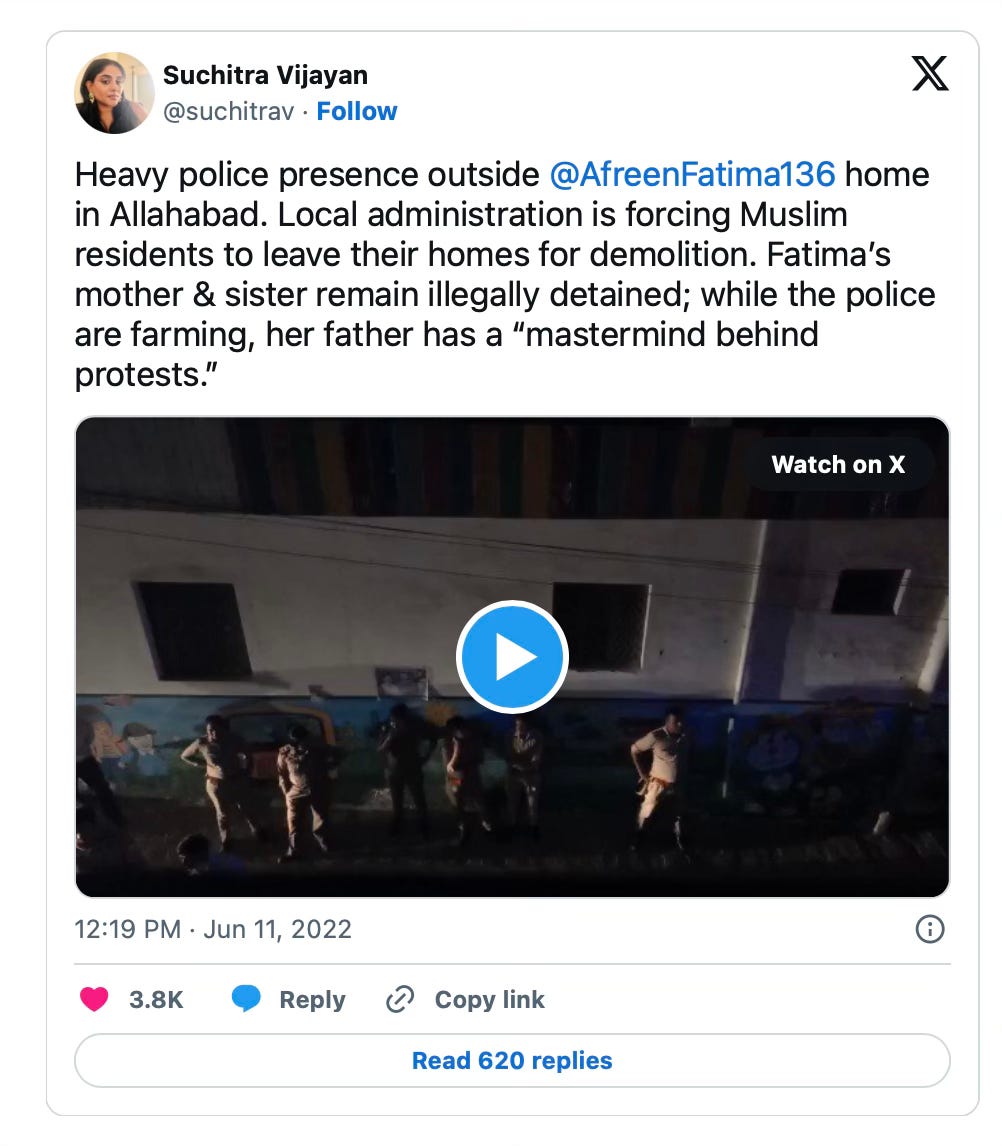
More here on the incident and bulldozer demolitions in India: The Demolitions Project (The Polis Project)
Others, away from this ground zero, like Ather felt the movement, despite dissipating, had galvanized a new hope. It created online communities and a way for people to exchange memory, information, and even contestations. In Bengaluru, Abdulla felt similarly, that for three months Shaheen Bagh and other satellite versions like her own Bilal Bagh were “a life force.”
“Where do we even gather otherwise in real life this way?” she asks. “All our spaces are commodified.”
When COVID happened, Abdulla says the same communities that had shown up first, the ghettos, were hardest hit. She threw herself into mutual-aid and relief work, which felt like an extension of the movement, a way to keep investing in the networks she had built.
Dr. Hossein takes a broader historical perspective. He calls the Shaheen Bagh movement and the subsequent accelerated authoritarianism a “moment of rupture,” that perhaps, now India’s and the world’s socio-political contracts will be reimagined.
“The CAA-NRC protest allowed for some public articulation of constitutional citizenship,” he says, “and a stronger expression of one’s Muslim identity. It allowed Muslims to glimpse into the past, to see the sort of arguments that might have happened during the Partition. It was a politics of recognition.”
He says that even though it didn’t change the result, the 2019-2020 protests initiated a conversation for civil society on what India’s Muslims, Dalits and other systemically marginalized citizens could expect in terms of equality. For 70 odd years, there was a certain “Nehruvian contract” as he calls it, a tacit understanding of protection, even if not equal access, between the marginalized and the dominant. But since the upper castes and elite never went away despite political independence from the British, seventy years later, the BJP had surged in and clung to power by making the populist interventions that served dominant groups, a social and political contract slowly coming undone.
Even here though, Hossein sees an opportunity, to re-examine and re-articulate what basic equality and rule of law can look like in this century, say versus social movements a hundred years ago.
Read Sara Ather’s recent work on Indian Muslim feminism here.
For Afreen Fatima, who like the incarcerated student activists, has also felt the full weight of the regime’s reprisal, this moment feels more urgent.
“The whole Hindutva project is based in supremacy of one group. The burden of secularism cannot be on the marginalized. Hindus have to fight it,” she insists.
In 2024, as Modi campaigned for his third term, indeed it seems like millions fought back. After two election cycles of resounding majorities in both houses of Parliament, this time the BJP barely scraped through, and has been forced back into forming a coalition government.
Abdulla sees this as cause for cautious optimism, the fact that in this moment the regime is forced to hold joint parliamentary committees, and opposition leaders have been elected back to their seats.
“We’re pushing back inch by inch by inch. For ten years we stayed put. That is the job, to remain in the present,” she says. “Of course, you must have an imagination for what you’re building. You have to do this little dance between now and the future. What is my role? How can I scaffold this movement, however defeated or fledgling or strong it is?”
Fatima doesn’t celebrate the 2024 democratic powers regained, and in fact fears that whenever the BJP’s grip on power weakens, violence escalates. She also believes that the hate they have stoked, regardless of if they are defeated in elections, will take years to extinguish. Her advice is one of caution, to reconsider what we think of as hope.
“Our resistance through our mere existence is where people should be looking for hope,” she says. “That we are not willing to give in, be silenced.”
Abdulla looks at these various articulations with her trademark artistic compassion. She leans into high comedic art as her final words, quoting Douglas Adams.
“You know, right now everyday feels like a tsunami. And all we have to fight it with is a towel,” she laughs. “I’ve got mine. And you’ve got yours. And we just have to hold on for dear life.”
Abdulla says her worst nightmare is to look back at these years and feel she should have done more. Each of these voices in their different articulations echo essentially the same sentiment: Resistance too, is a democratic right. They will not go quietly into the night.