
On Drawing:
Some thoughts on seeing and unseeing during a genocide.

I've been taking a charcoal class in the middle of a genocide. Every Sunday, as the bodies pile up in Gaza, I go into a neon-lit room of a rec center, walls covered with smiling faces in pictures doing all the things white people do to evoke joy in their own bodies–– holding chickens on a farm, children prancing in prairies, tap dancing classes, jazz hands, and miming mouths. I don’t think of them as “white” when I actually look at the artistic black and white photographs. I just see smiling faces, shining eyes. I see people alive. I’m saltier about race when I start to write about it, feeling the weight already of a white reader’s gaze on my brown fingers, my brown ways of looking.
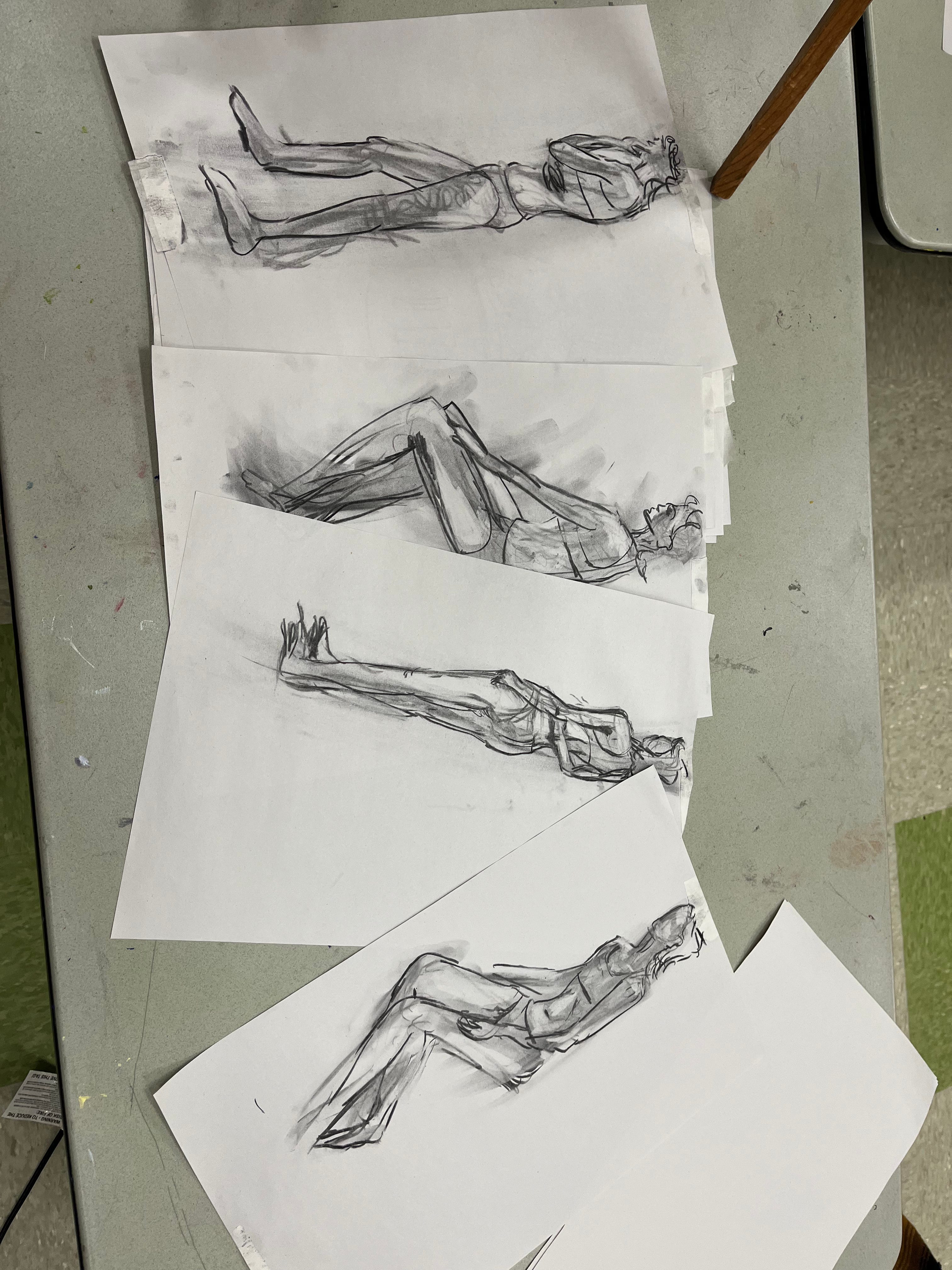
Inside the class, we sit in our circle with newsprint paper, a delicate brittle stick of charcoal that immediately stain my fingers black, and tape–– lots and lots of tape to paste fresh white sheets over and over__ a sculpture to our fading artistic ineptness, a signboard that we are evolving past our “I-wish-I-could-draw” stage into someone who will make mch-mch sounds with earned smugness at museum walls.
Slowly as the class settles, our instructor, a messy-chic artist herself who speaks in drawn-out -ees in that Midwest way my ears have learned to recognise, takes to the board. As she reviews what we know— scribble figures and boxing out our model and focusing on the gravity of where the body’s weight lies— I watch the model disrobe to their level of comfort, in this case their underwear. Something about being in this intimate space, the charcoal stick turning to dust on our skins makes the model less human: they’re objects in this moment we must not admire for beauty or scorn for flaws, we only see a subject for our study, a body whose presence makes us better artists, giving us something to aspire to, allowing us to retain our right to aspiration, to humanity.
As the instructor sets the timer and starts us off, I follow what she has taught me: “Don’t think too much. Draw a gesture line in the air first.” Which means we swish our charcoal sticks like little magic wands to mimic the broad strokes the model’s body is creating in the space. Then we let muscle memory repeat it as dust touches paper. “Look more at the figure, less at your markings of it. Let your fingers trace what your eyes see.” This movement draws blood to my fingers in a way I’m acutely aware, neurons in my brain turning electric signals to moving, flowing lines of burnt tree on a surface of wood pulp. If I was a white self-help, pop-psychology guru on Instagram I would think at this point about our inter-connectedness. But here I stand feeling deeply unconnected. I’m a brown woman, with a very different Instagram feed, and I’m here to feel a little less unalive.
Two days ago, they found a body in Gaza–– or really a mashed, disfigured remainder of one. In a blurred-out picture on Instagram, a man’s right arm is the one thing visible in sharp focus–– the only thing whole about this severed arm is the zip tie still encircling his wrist. Everything else from his torso, his pelvis, his limbs have been torn open under the wheels of an armored vehicle. Someone has made an Instagram graphic saying, “I know now how much a military tank weighs, information I never thought I would need.” Someone else has made an illustration: a man sprawled like the real human in the picture, except where his flesh was torn and blood and bone spilled, this artist has covered with red flowers. I see people like these everyday trying to mock this world out of its stupor to confront this unrelenting cruelty, and simultaneously dignify the dead, infuse in them the humanity they weren’t offered in their last moments. Each of us is becoming practiced in holding intense rage and all-consuming grief not even in two whole hands, but in our fragile typing thumbs and fingers.
I am not an artist by any measure. My mother is. She tried to teach me some basic drawing and coloring skills as a child, but I quickly grew disenchanted with the process when I discovered she wanted me to start by learning to remain within lines. It felt like a fairly thinly veiled lesson in womanhood, one I would spend a lifetime arguing. It was only in college during a freshman drawing class when a classmate–– herself an accomplished artist nudged me to pay attention instead to light and darkness. “That’s all. Your perception really is, degrees of darkness and brightness our eyes, brains, and fingers are constantly reading,” she told me. I immediately attached to this more amorphous and inviting instruction. Within this rule I was free to see. Not only did it mean I didn’t need to agree with the one standard way of what a tree or horse or wrinkled grandmother’s face must look, with that delicate balance of both control and letting go I could manipulate my way of seeing the world.
I start to draw, filling in dark smudges where this human’s thigh meets her knee, her stomach rolls wave over and under the band of her underwear. I find myself thinking of trees; how our first fascination with trees as babies is hardly informed by the usefulness of a tree to our life–– the oxygen, photosynthesis, the products, and resources–– that human-centric valuation of a tree comes later, often in elementary school and it becomes hard to unsee the world that way ever after. But before we force on these permanent anthropocentric spectacles, a child simply sees a being playing with the ample light and shade of this planet, its vastness still incomprehensible to the child’s mind, but its wonder acutely clear. As a child too, I remember watching light dapple through leaves, and cast leaf-shaped shadows on trunks and trunks forming elephantine pathways in the woods. But I always somehow remember seeing humans as something I could attach a value to. “Will she feed me?” “How much must I cry so he will relent and buy me that toy?” “Does she love me?” “Is he rich?” “Do they think I’m pretty?
A mother in Gaza rose from under the debris of her Israel-bombed home to immediately search for her children. She spotted something. A dismembered leg. Her son’s. She let out a wail. “She recognized her son’s leg in a way only a mother can,” the article said. How does a mother, artist-like, study this subject of all her attention? Mothers don’t remember their children in light and shade. There are no optic nerves involved in the knowing of one’s children. I know my son’s every feature because of how I hold my son. Even though he’s practically a teenager I often embarrass him and pull him into my lap like a toddler. As the smell of his hair fills my nostrils, and he folds his long limbs in half to cushion into my belly pouch where I once held him, I know how tall he is. I could mark it on a street hair to toe.
As I draw the model’s back, little charcoal notches for every dark dot where her vertebrae protrude under her delicate skin, I think of this mother’s son, who the article says was thankfully alive, yelping for her from across the debri pile that was once their living room. His one leg had blown off and the other while still attached to him had its delicate skin ripped down the back, to reveal white macerated bone. “I usually take an ibuprofen twenty minutes before I have to pose…” I hear the instructor telling the model during our next break. “It helps to hold the pose longer, to numb the inflammation from where the bones have stayed static too long.” Humans think about bodies all day. Our own, those of people we love, scraps we know of their physicality because we’ve held them or been held, others we only know and think of in the silhouette of our own longing and desire. But only Palestinian bodies have been on my mind for five months now. I see them piled high in open carts drawn by horses, children still wearing their Adidas t-shirts, like some fucked up medieval painting. I see them emerge in parents’ palms, bit by ravaged bit from under the rubble. I’ve seen mothers cradling tightly wrapped shrouds like a child hugging her favorite outsized toffee. Young children with only two of the four boxes the instructor has taught us to divide the human into: head, torso, pelvis, limbs. There are heads and torsos, and gauzed stubs for phantom legs. A boy lying where his mother’s belly pouch would have been under a blood-soaked blanket that now covers her, his eyes two dim dark holes. In this world where my eyes are thousands of miles away from them, I can smell and touch and feel these bodies more viscerally than the slow decaying self I encounter in my bathroom mirror each morning.
When we finish our last round of timed drawing, we circle around the room admiring the work of others. It’s true, all that instruction we’ve received. It’s worked. We’re all starting to draw. The verb circles with me around the room. We draw water, we draw figures, we draw guns. The first is life-giving, the last ends it. Somewhere in the middle, we enter a contract to see the other–– a body smiling, miming, pushing jazz hands into the world, and newborn chickens into your face. We acknowledge each body’s hidden corners; we learn to love its open wounds. We let electric signals in our brain turn to beauty in our fingers. One of the students in the class hovers over my workstation, waiting for me to return from my pilgrimage. Each of us has drawn, interpretated, seen this one human in eight different, wholly unique ways. The person at my table tells me she loves how I captured their belly’s curve. “There’s a flow to it I want to learn how to do…” she trails off or perhaps I stop listening. As I said I’m only half sensorially available to my own world, thousands of miles from broken children these days. All I remember now are her sparkling green eyes, which I file away next to the zip-tied severed arm in my brain. I mumble thank you and hide away my sheets, embarrassed at my unavailability, my desperation to see what is alive now only when juxtaposed by what no longer is.
As we finish class and bid the instructor goodbye I pause by the doorway, hesitating to thank the person who modeled. Do I actually see them as a person or were they simply a body for me? I’m flushed at how lost I feel there at this threshold of moral insanity. Do I thank them for making their body available for the sad benefit of training me in an art form I will never add to my resume? Do I pretend I can see their full humanity when all I see is flesh and blood on hourly hire? Shall I tell them I still loved drawing the way their hair brushed the nape of their neck and an errant clump curled under one ear when they hunched over, from exhaustion sometimes, the Ibuprofen perhaps not working? My throat feels full as if I’ve swallowed a burning tree. Everything hurts and feels fragile inside, like a twenty-five-year-old American man-boy coming apart in ashy wisps screaming, “I will not be complicit in genocide.”
I avoid the model’s eyes instead and flee from the neon-lit room, and out into the blinding evening sun.
Thank you for sharing this. There were many moments where my eyes welled up.